
Siberian pelmeni are filled dough parcels boiled in water or broth — one of the dishes most often called Russian national food. They are eaten either as a soup garnish or as a main course.
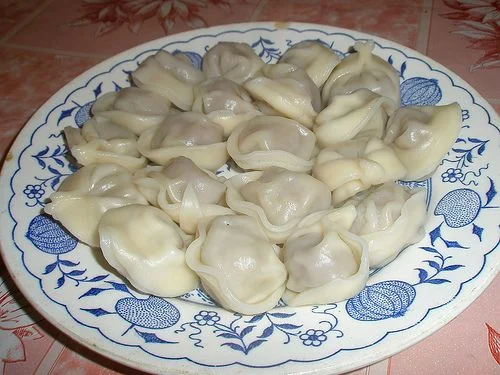
Pelmeni (and many other Russian dishes) are served with smetana — a kind of soured cream with 20–40% fat, somewhere between European sour cream and crème fraîche.
The dough is made from flour, salt, water and, optionally, eggs. It is rolled out like noodle dough; small circles are cut with the rim of a wine glass, filled, and folded into half-moons. The classic filling, as recorded in the Russian Wikipedia, is a mix of 45% beef, 35% mutton and 20% pork. Sweet variants exist — with curd cheese and cherries, strawberries or raisins — as do fillings with mushrooms, finely chopped white cabbage, or fish. Dough parcels without meat filling are called vareniki.
Pelmeni are not dried like other pasta but frozen. Siberian pelmeni in particular are made in large batches and, in winter, simply placed in sacks outside or buried in the permafrost for storage.
They are served with melted butter and/or vinegar, with smetana, with mustard, with a mixture of chopped garlic and/or onion, vegetable oil, vinegar, salt and pepper — or with one of the many sauce variants.
The word itself comes from the Finno-Ugric peoples of northern Russia; in Udmurt, pelnyan means roughly “dough ear”. By another account, pelmeni were brought south by Turkic nomads from northern China.
Very similar dishes are found across Eurasia: Italian tortellini and ravioli, Swabian Maultaschen, Chinese jiaozi and wonton. Jewish cuisine has kreplach; in Central Asia, manti are everywhere.
At our restaurant Siberian pelmeni are folded by hand every morning. We serve them with smetana, with butter and herbs, or in a clear broth.